Home Fire Safety: 5 Overlooked Fire Hazards and How Smoke Detectors Protect You
Five overlooked home fire hazards and how to fix them, how ionization and photoelectric smoke detectors work, and why monitored detectors matter when away.

Sprinkler bulb colors show the temperature that sets each head off. See the color chart, why the right rating matters, and when to have heads checked.
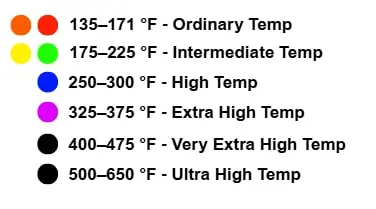
The color of the liquid inside a fire sprinkler's glass bulb tells you the temperature at which that sprinkler will open. Orange and red bulbs are ordinary temperature (135 to 170 F) and are the most common in offices, stores, and homes. Yellow, green, blue, purple, and black bulbs are rated progressively hotter for spaces like kitchens, attics, and equipment rooms, so the right color depends on the normal heat in the room.
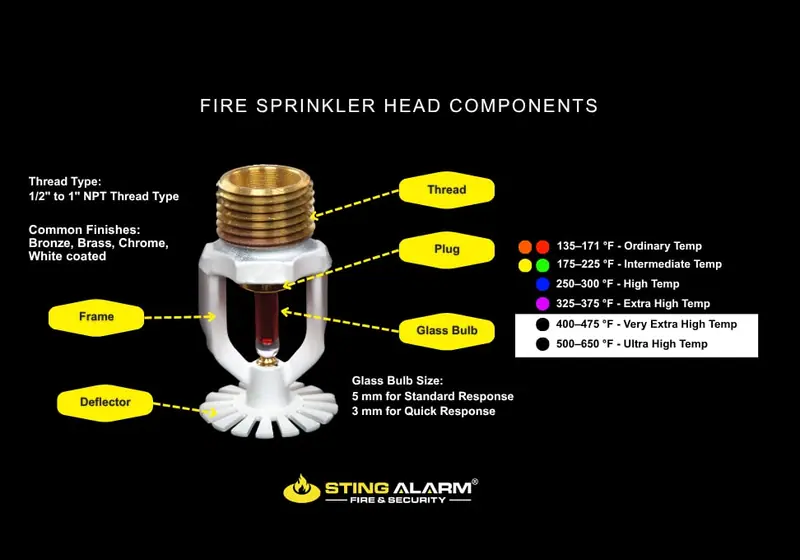
Inside each sprinkler head is a small glass bulb filled with a heat-sensitive liquid. It holds a plug in place against the water pressure in the pipe. When the air around the head reaches the bulb's rated temperature, the liquid expands, the glass breaks, the plug drops out, and water hits the deflector and sprays over the area below.
Each head works on its own. Only the heads that get hot enough open, which is why sprinklers can control a fire close to where it starts.
The color codes come from NFPA 13, the national standard for installing sprinkler systems (NFPA: the basics of sprinkler thermal characteristics).
| Bulb color | Temperature classification | Rating |
|---|---|---|
| Orange or red | Ordinary | 135 to 170 F |
| Yellow or green | Intermediate | 175 to 225 F |
| Blue | High | 250 to 300 F |
| Purple | Extra high | 325 to 375 F |
| Black | Very extra high | 400 to 475 F |
| Black | Ultra high | 500 to 575 F, and 650 F |
The rating has to sit comfortably above the highest temperature the space normally reaches. Dining rooms, gaming floors, and offices typically use ordinary orange or red bulbs. Commercial kitchens, unvented attics, skylights, and rooms with heat-producing equipment often need intermediate or high ratings so a head does not open from normal heat. A head rated higher than the space needs can open later than it should in a real fire.
Choosing the rating is not a preference. It is part of the system design and the code.
Business owners often assume a sprinkler system is compliant because the heads are there. Conditions change over time:
Any of these can lead to a failed inspection or a system that does not perform as designed.
Fire Prevention Month is a good reminder to confirm your system has been inspected on schedule, your records are current, and any deficiencies from the last report have been fixed. Our fire sprinkler and fire alarm inspection and maintenance team handles recurring inspections, sprinkler flow tests, and repairs in house, and keeps the reports you need for the fire marshal.
When fire protection, intrusion, and video are handled by different vendors, reports end up in different places and nobody owns the whole picture. Sting Alarm provides Integrated Security and Fire Protection from one vendor: fire protection services, business security systems, and fire alarm monitoring from our UL-listed monitoring center. Same-day service is often available for existing customers, depending on technician availability. After-hours rates may apply.
Not sure when your sprinklers were last inspected? Call us at (702) 737-8464 and we will review your system and records.
The color of the liquid in a sprinkler's glass bulb shows its temperature rating, the point at which the bulb breaks and the head opens. Orange and red are ordinary temperature (135 to 170 F), yellow and green are intermediate (175 to 225 F), blue is high (250 to 300 F), purple is extra high (325 to 375 F), and black covers the very extra high and ultra high ratings (400 F and up).
No. In a standard wet pipe system, each head opens on its own when the heat at that head reaches its rating. Only the heads near the fire activate.
Only with a head of the same temperature rating, type, and response that the system was designed for. A head with the wrong rating can open too early near a heat source or too late in a fire. Replacements should be done by a licensed fire protection contractor.
Heads should be replaced if the bulb is empty or cracked, the head is painted, corroded, or loaded with dust or grease, the head was damaged, or the space has changed in a way that needs a different temperature rating. These are the kinds of conditions an inspection is meant to catch.
Five overlooked home fire hazards and how to fix them, how ionization and photoelectric smoke detectors work, and why monitored detectors matter when away.
How access control, video surveillance, and Remote Guarding each fit HOA security in Las Vegas and Phoenix, and how boards can choose the right mix.
Business security cameras can show traffic patterns, queue lengths, occupancy, and busy areas. See what video analytics reveal for Las Vegas businesses.
★★★★★ Sting Alarm has been great to work with. Had an issue that needed a field tech to come out. Mike was dispatched and worked on the issue - quickly identifying the issue and resolving it for me. Friendly and great service!
★★★★★ From the beginning, Sting Alarm has been so easy to work with. From Jeff in Sales, to scheduling, and finally when our tech came out in a Saturday for the installation, everything was seamless. Our tech Isaac was fantastic. He was neat and cleaned up after the installation, and took time with me and my husband to get us set up on the app. He was patient, walking us through all the features.… Read on Google
★★★★★ Mike in service is an amazing tech. This morning he came out to replace our faulty smoke detector. He was professional, efficient, really friendly and took the time to explain everything clearly. The whole process was quick and stress-free—highly recommend Mike and Sting Alarm