
StingNet: AES-IntelliNet Radio Alarm Monitoring
StingNet is Sting Alarm's private AES-IntelliNet radio mesh network. Fire alarm signals reach our monitoring center in 1 to 3 seconds, no phone line needed.
StingNet is Sting Alarm's private AES-IntelliNet radio network, built only to carry critical alarm signals from your building to our monitoring center. Every connected site has a subscriber radio that sends its own signals and relays signals for others, forming a mesh with more than one path to the monitoring station. Your fire alarm does not need a phone line, and a signal is accepted by redundant receivers in 1 to 3 seconds.
How StingNet works
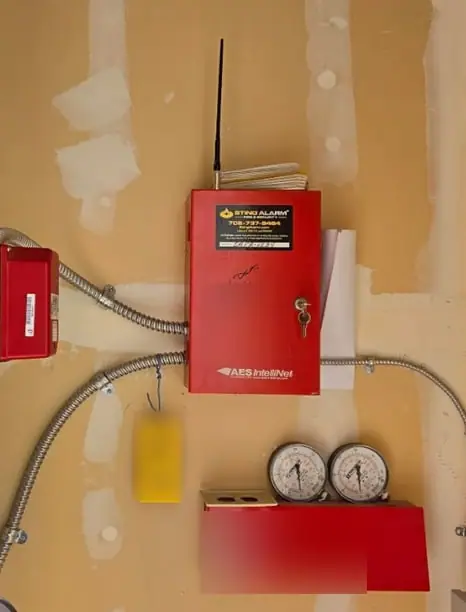
StingNet is made up of subscriber units that act as signal receivers, transmitters, and repeaters. Each alarm site is linked to the network by a subscriber with a built-in transceiver (radio), and together the subscribers form a dedicated alarm network that sends alarm signals to the central monitoring station. A signal moves in three steps:
- Your panel hands off the signal. The alarm panel is connected to a subscriber that receives and transmits the critical event signal.
- The mesh finds the fastest route. The signal travels the fastest route over the multi-path mesh network to the Internet.
- Redundant receivers accept it. Redundant receivers at the central monitoring station accept the transmission in 1 to 3 seconds.
AES Corporation describes the technology this way: "Multiple path validation logic is the heart of AES technology, with no single point of failure" (AES wireless mesh technology).

Why a private radio network matters for life safety
A fire alarm is only useful to the fire department if its signal gets out of the building. StingNet is built around that one job.
- No phone line in the path. Signals travel by radio, so a cut, noisy, or disconnected phone line does not stop them.
- No single cellular carrier. StingNet is a private, dedicated network used only for critical alarm event signals. AES notes that minimal reliance on public service providers means "no dealing with cellular sunsets" (AES Corporation).
- More than one way through. Each subscriber can repeat signals for its neighbors, so if one route is unavailable, the signal can take another.
- Redundant receivers. More than one receiver at the monitoring station can accept the transmission.
- Fast delivery. Signals are accepted in 1 to 3 seconds.
- Built to keep working. The technology is rugged, designed to withstand extreme conditions, and designed to remain operational when other alarm communications fail.
Who needs radio alarm monitoring
Any building whose fire alarm has to reach a monitoring center reliably is a good fit for radio communication. That includes:
- Commercial fire alarm systems in offices, retail, warehouses, medical buildings, and other commercial properties that need 24/7 fire alarm monitoring.
- Businesses replacing old phone lines (POTS). If your fire alarm still dials out over a traditional copper phone line, a radio communicator removes that line from the signal path.
- Multi-site properties. Owners and managers with several buildings can put every fire alarm on the same private network and the same monitoring center.
How StingNet works with Sting Alarm
StingNet is one part of Life Safety Fire Protection from one vendor. Signals that arrive over the network are handled by our UL-listed monitoring center around the clock. Alarm signals are dispatched to the fire department, and supervisory and trouble signals go to you or your designated contacts.
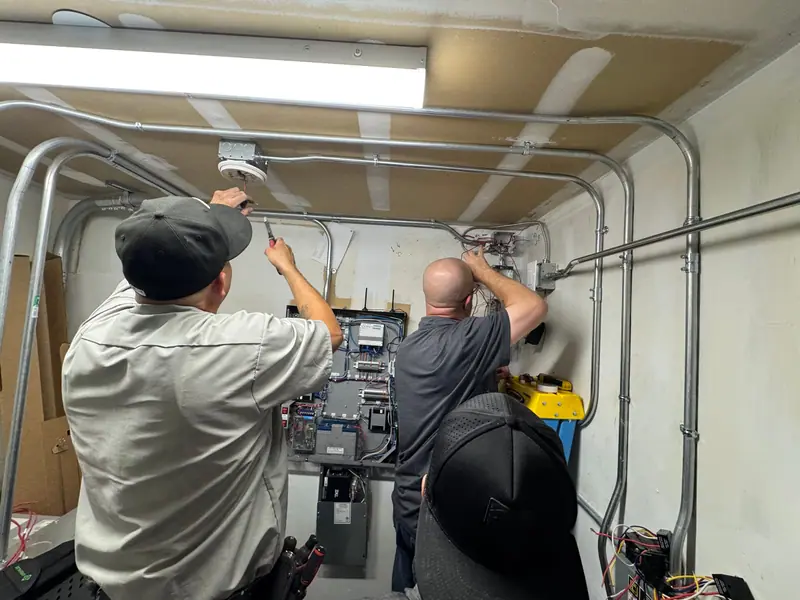
Behind the network is a licensed fire contractor. Sting Alarm holds Nevada Fire Protection License C41-0090059 and Nevada Fire Marshal licenses E292, F602, and G1209, plus Arizona ROC licenses CR-16 #359059 and CR-67 #357917. Our technicians install the subscriber radio, connect it to your fire alarm panel, and keep the whole system on schedule with fire inspection and maintenance. Phoenix-area properties can learn more on our Phoenix fire alarm monitoring page.
How radio compares to phone line, cellular, and internet communicators
Each communication path can work. They differ in what they depend on.
| Path | What the signal depends on |
|---|---|
| Phone line (POTS) | A working copper phone line and phone service at the building |
| Cellular | A public cellular carrier's network and the communicator's support for that network |
| Internet (IP) | The building's internet service and the network equipment that carries it |
| StingNet radio | A subscriber radio at the site and the private AES-IntelliNet mesh network |
Cellular and internet communicators are widely used and are a sound choice for many systems. For security, our standard panel is the Qolsys IQ Panel 5, which is dual-path with a built-in cellular communicator, and we install a backup battery in the panel so it stays online during power outages. For fire alarm communication, StingNet adds a path that does not depend on a phone company, a cellular carrier, or the building's internet service. If you are planning a new system, see our business security systems for how fire and security fit together.
How to switch to StingNet
- Tell us about your building. Share the address, your fire alarm panel, and how it communicates today.
- We evaluate the system. We look at the panel, its current communication path, and its inspection records, then recommend what, if anything, needs to change.
- We install and connect. Our technicians install the subscriber radio, connect it to your panel, and test signals to our monitoring center.
- We keep it working. Monitoring, inspections, and service stay with one local team.
Ready to take your fire alarm off the phone line? Request a free quote or call (702) 737-8464 in Las Vegas or (602) 431-1300 in Phoenix.
Ask about switching to StingNet
Tell us about your building and how your fire alarm communicates today, and our fire protection team will reach out.
What happens next
Over 1,000 five-star Google reviewsFrequently asked questions
What is AES-IntelliNet?
AES-IntelliNet is wireless mesh radio technology from AES Corporation, which makes communications products that create private mesh networks for fire, security, and facility applications. StingNet is Sting Alarm's private AES-IntelliNet network.
Does StingNet need a phone line?
No. Each alarm site connects to StingNet through a subscriber with a built-in radio transceiver, and signals travel over the private radio mesh network to our monitoring center. A phone line is not part of the signal path.
How fast are alarm signals delivered?
The signal travels the fastest route over the multi-path mesh network, and redundant receivers at the monitoring station accept the transmission in 1 to 3 seconds.
What happens if cell service goes down?
StingNet does not rely on a cellular carrier. It is a private, dedicated network used only for critical alarm event signals, and it is designed to remain operational when other alarm communications fail.
Can I switch my existing fire alarm to StingNet?
In many cases, yes. We evaluate your fire alarm panel, its current communication path, and its condition, then tell you what is needed to connect it to a StingNet subscriber radio and our monitoring center.
Who monitors the signals sent over StingNet?
Signals are received by our UL-listed monitoring center, which handles fire and security signals 24 hours a day. Sting Alarm is a licensed Nevada fire protection contractor, so the same local team can also install, inspect, and service your system.