
Medical Office Security: Access, Video, False Alarms, and Fire Compliance
What security a medical office needs: access control, video, after-hours protection, fewer false alarms, and monitored fire alarms, from one local team.
A medical office needs access control for entrances and restricted rooms, cameras on entrances and medication or supply areas, a monitored alarm for after hours, a monitored fire alarm, and procedures that keep false alarms down. Clinics face a mix of risks other offices do not: patients and visitors coming and going all day, prescription drugs and costly equipment on site, sensitive records, and staff who arrive early and leave late. Sting Alarm provides integrated security and fire protection for medical offices and medical buildings in Las Vegas and Phoenix.
Top security challenges for medical offices
1. Protecting patient records and data
Patient information is a target, on paper and on computers. Building security cannot replace a practice's privacy policies, IT safeguards, and training, and it does not by itself make a practice compliant with any law. What it can do is keep unauthorized people away from records rooms, server closets, and workstations, and create a record of who entered those spaces. Your compliance advisor should guide your practice's privacy program. For the cyber side of your security system, read our post on cybersecurity awareness for business security systems.
2. Preventing unauthorized access
Medical offices often have several entry points: a front door, staff entrances, deliveries, and sometimes shared hallways in a medical building. Unauthorized access can lead to theft of equipment, records, or prescription drugs.
3. Continuous video coverage
Reception, waiting rooms, hallways, and back doors all need coverage, and older camera systems often leave gaps or produce footage that is hard to use.
4. After-hours protection
Practices sit empty overnight and on weekends with valuable equipment and medications inside. An unmonitored building may not be noticed until staff arrive the next morning.
5. Fire safety and emergency preparedness
Medical offices use electrical equipment, oxygen in some practices, and supplies that burn. Patients may need help getting out, so early detection and a clear evacuation plan matter.
6. Managing cost
Budgets are tight. The goal is protection sized to the practice, with features chosen for real risks rather than a long equipment list.
Access control and video for clinics
Access control
Access control replaces keys with credentials that can be changed instantly. For a clinic, that means:
- Restricted rooms stay restricted. Medication storage, records, labs, server closets, and supply rooms open only for the staff who need them.
- Schedules match your hours. Doors unlock for business hours and lock automatically after.
- Turnover is simple. Add a new hire in minutes and remove a departing employee the same day, with no rekeying.
- Every entry is logged. You know who entered which room and when.
- Multi-location control. Practices with more than one office can manage every location from one platform.
Video surveillance
Video surveillance covers entrances, reception, hallways, medication and supply areas, parking lots, and back doors. Cameras tied to access control attach video to each door event, so if a credential is used after hours, you can see who used it. Cameras also help review incidents with patients or visitors and provide evidence for police and insurance when something happens.
False alarms and alarm fatigue: costs and fixes
The false alarm problem
False alarms are common across the security industry. The U.S. Department of Justice COPS Office guide False Burglar Alarms, 2nd Edition (Rana Sampson, 2011) reports that between 94 and 98 percent of alarm calls are false, and that in 2002 U.S. police responded to approximately 36 million alarm activations at an estimated annual cost of $1.8 billion. The same guide cites a U.K. study that found user error caused about 50 percent of alarm activations.
What causes false alarms in a medical office
- Staff triggering the system while entering or leaving early or late
- Wrong codes or forgetting to disarm before opening a door
- Motion sensors aimed at HVAC vents, windows, or moving objects
- Aging equipment and dead batteries
- Cleaning crews or vendors who were not trained on the system
What alarm fatigue does
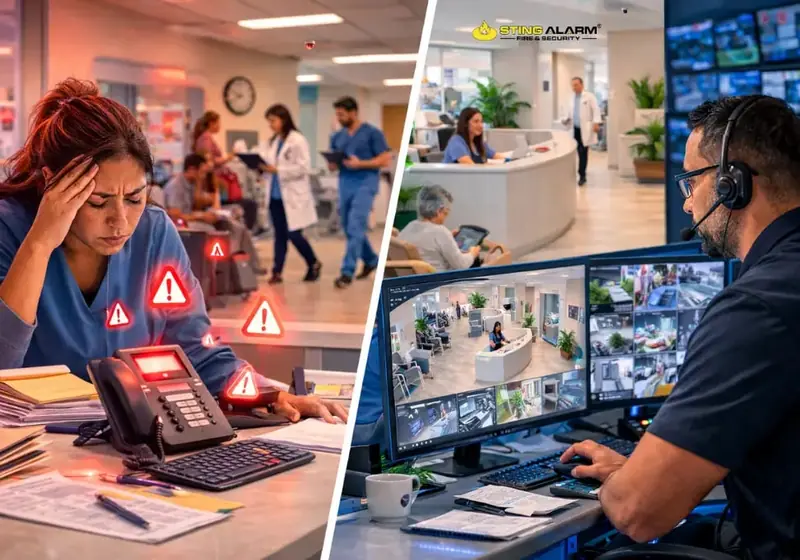
Alarm fatigue happens when people hear so many false or low-priority alerts that they stop taking any of them seriously. Healthcare workers already know the problem from clinical alarms, and the same thing happens with building security. Staff assume the alarm is false and respond slowly. Managers start ignoring alerts on their phones. Trust in the system drops, and a real break-in is more likely to be missed.
What false alarms cost
- Direct costs. Many jurisdictions charge fines or fees for repeated false alarms, and repeated dispatches strain the relationship with responders.
- Operational costs. Someone has to answer the call at 5 a.m., drive in, check the building, and file paperwork, and the morning schedule suffers.
- Hidden costs. A system people do not trust becomes a burden instead of a safeguard.
How to reduce false alarms
- Design it right. Place sensors where heat, airflow, and movement will not set them off.
- Train everyone. Give staff, cleaners, and vendors clear arming and disarming procedures and their own codes.
- Maintain it. Test the system and replace batteries and failing devices on schedule.
- Verify with video. Video verification ties alarm events to cameras so a person can see what happened before escalating. A wrong code is cleared without sending anyone, and a real intrusion is reported with details.
- Add live response. With remote guarding, trained operators watch live video, speak to anyone on site through speakers, and contact law enforcement only when it is real.
- Integrate security and fire. One provider for both systems coordinates settings, maintenance, and records.
Fire alarm monitoring and compliance
Fire protection is the backbone of life safety in any medical building. A monitored fire alarm sends signals to our UL-listed monitoring center, which dispatches the fire department even when the office is closed.
For fire alarm communication, Sting Alarm offers StingNet, our private AES-IntelliNet radio mesh network. Signals take the fastest route over the mesh, and redundant receivers at the monitoring station accept them in 1 to 3 seconds, with no phone line in the path. Learn more about fire alarm monitoring.
Your local fire authority sets inspection and testing requirements based on the adopted fire code and your building's use. Changes like new exam rooms, moved walls, or a new tenant in a medical building can affect detector and notification coverage, so have the fire alarm reviewed whenever the space changes. Sting Alarm inspects and services fire alarms, sprinklers, and extinguishers, including sprinkler flow tests and hydrostatic extinguisher testing done in-house, and keeps the records inspectors ask for. For more detail, read fire protection for medical offices.
The right mix for your practice
Every practice is different. A single-provider office in a strip center needs different coverage than a multi-floor medical building with several tenants. A typical plan includes:
- Monitored intrusion detection with door, motion, and glass break sensors
- Access control on entrances and restricted rooms
- Cameras with video verification
- A monitored fire alarm with regular inspection
- Remote guarding for buildings that sit empty and exposed after hours
- One app to manage it all, and one local team to support it
Sting Alarm has been local and independently owned since 2003. Call (702) 737-8464 in Las Vegas or (602) 431-1300 in Phoenix, or request a free quote.
Get a free medical office security review
Tell us about your practice, your hours, and your building, and a local security expert will recommend a plan.
What happens next
Over 1,000 five-star Google reviewsFrequently asked questions
What security does a medical office need?
Most practices need access control for entrances and restricted rooms, cameras covering entrances, reception, and medication or supply areas, a monitored intrusion alarm for after hours, a monitored fire alarm, and clear procedures so staff arm, disarm, and respond the same way every time.
Does a security system make a medical practice HIPAA compliant?
No. Patient privacy obligations involve policies, training, and IT safeguards that go well beyond a building security system. Physical security measures like access control and cameras can support a practice's broader privacy and safety efforts, and your compliance advisor should guide what your practice needs.
Why do medical offices have so many false alarms?
Staff often arrive early, leave late, and move between secured areas, so arming and disarming mistakes are common. Poorly placed motion sensors, aging equipment, and environmental triggers add more. Good design, clear procedures, maintenance, and video verification reduce them.
What is alarm fatigue?
Alarm fatigue happens when people hear so many false or low-priority alerts that they start to ignore or delay their response to all of them. When alarms feel routine, a real event is more likely to be missed.
How does video verification help a medical office?
When an alarm trips, a camera covering that area shows what actually happened. If it was an employee who entered the wrong code, the event can be cleared without sending anyone. If it is a real intrusion, it can be reported with a description of what is happening.
Can one company handle a medical building's security and fire alarm?
Yes. Sting Alarm designs, installs, monitors, and inspects both security and fire alarm systems, so a practice or medical building has one vendor, one schedule, and one set of records.