
Business Security Checklist: A Year-Round Review for Las Vegas and Phoenix Businesses
A year-round business security checklist for Las Vegas and Phoenix: entry points, lighting, theft, seasonal risks, year-end review, and staff training.
A business security checklist should cover entry points and locks, lighting and visibility, alarm and camera coverage, access credentials, fire protection, monitoring instructions, and staff training, and it should be reviewed through the year, not just once. Risk changes with the seasons: tourist spikes, summer heat, holiday crowds, and holiday closures each open different gaps. Use this checklist to review your property, and call Sting Alarm if you want a local expert to walk it with you in Las Vegas or Phoenix.

Entry points, lighting, and visibility
Check every entry point
Doors, windows, and service entrances are where most break-ins start.
- Exterior doors should have strong locks and close and latch properly every time.
- Windows and storefront glass should be secured, and glass break detection added where glass is the easiest way in.
- Delivery and service entrances should be restricted to authorized people and covered by a camera.
- Roof hatches, back alleys, and side gates are easy to forget. Include them.
Light the property
Good lighting deters intruders, helps employees feel safe, and makes camera footage usable.
- Light entrances, parking lots, and walkways.
- Add motion-activated lights in areas used less often.
- Replace burned-out fixtures quickly.
Keep sightlines clear
Trim shrubs and remove stacked pallets, dumpsters, or signage that give someone a place to work unseen. Clear visibility improves security without any new equipment.
Burglary, shoplifting, and employee theft
Most business losses come from three threats. Each needs a different response.
Burglary
A lock and key alone are not enough. A monitored alarm with door and window sensors, motion detection, and glass break detectors tells our monitoring center the moment someone gets in. Cameras tied to the alarm let someone confirm what is happening, and smart locks let you check and lock doors from your phone if someone forgets. Businesses that get hit repeatedly are usually relying on an old camera in a corner or a sticker on the door. Systems that detect suspicious behavior early, with lights, live voice warnings, and instant alerts, react in the moment instead of after the damage. For businesses that sit empty overnight, remote guarding puts a live operator on your cameras.

Shoplifting
- Keep high-value merchandise in locked cases or behind the counter.
- Station a trusted employee where they can see and greet everyone who comes in. Shoplifters avoid stores where someone is paying attention.
- Cover the sales floor, high-value displays, and exits with video surveillance, and keep the cameras visible.
Employee theft
- Use access control so people enter only the areas their job requires, at the hours they work.
- Avoid leaving one person alone with cash or high-value stock.
- Review access logs, arming and disarming times, and video regularly.
- Make background checks part of hiring.
- Remove credentials and change codes the day someone leaves.
Seasonal shifts: tourist spikes, summer, and holiday closures
Risk in Las Vegas and Phoenix follows a rhythm. The goal is not to replace systems each season but to keep them configured for how the property is used right now.
Tourist spikes and peak traffic
Conventions and peak travel periods bring more movement through retail, hospitality, warehouse, and mixed-use properties. Entrances, loading zones, and parking areas get heavier use.
- Adjust access control schedules for longer hours.
- Check that temporary displays, signage, or staging areas are not blocking camera views.
- Watch areas staff cannot see during rush periods, and make sure employee-only areas stay locked.
Inventory surges
Holiday and convention seasons often mean more stock. Warehouses stack higher and stockrooms expand. Higher shelving can block camera sightlines and change how motion detection behaves, so recheck coverage and tune analytics when storage changes.
Seasonal hiring
Temporary staff and rotating vendors add active credentials. Audit access before and after peak hiring, and set temporary credentials to expire when the job ends.
Summer heat
Las Vegas and Phoenix summers are hard on exterior equipment. Prolonged heat and dust can affect camera clarity and sensor performance. Inspect outdoor cameras, enclosures, and exposed hardware, and confirm network equipment is ventilated. Summer vacations also mean quieter offices and leadership away, so make sure alerts reach someone who is available.
Holiday closures and busy holiday days
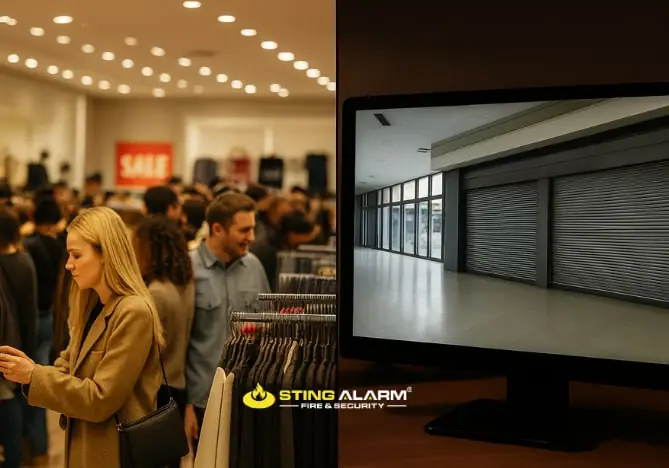
The holidays create two opposite risks. When the building is empty, the priority is early detection, real-time alerts, and deterrence: monitored alarms, video analytics that work in low light, and live voice warnings from remote guarding. When the building is packed, the priority is awareness: cameras on blind spots, secured employee-only areas, and fire protection that keeps up with higher occupancy. Mischief days and slow nights bring vandalism too, so cameras on exterior walls and storefronts matter year-round.
Year-end review: tests, reports, documentation, vendors
Before January, run a five-step review.
- Test the systems. Check intrusion alarms, monitoring signals, cameras, access control schedules, fire alarm panels, notification devices, and communication paths. Confirm coverage still matches how the business operates after a year of changes.
- Review monitoring and activity reports. Look for repeated false alarms, unusual after-hours access, and areas with frequent motion alerts. These point to camera, permission, and alert changes worth making.
- Confirm documentation. Make sure inspection reports, monitoring certificates, service records, and access audit trails are complete and easy to find. Missing paperwork is one of the most common issues found during inspections.
- Evaluate vendors. Separate providers for fire, security, cameras, and monitoring often mean duplicated costs and slower answers. Consolidating with one vendor simplifies service and records.
- Plan for next year. Account for new locations, longer hours, staffing changes, and budget. If you are paying for guard coverage, compare it with remote guarding, which typically costs 60 to 80% less than a full-time on-site security guard.
Training staff on security awareness
Employees are part of the system. When they know what to look for and how to respond, every other measure works better.
- Teach staff to report suspicious activity right away, and make it easy to do.
- Make sure everyone knows how to arm and disarm the system, what to do when it alarms, and who to call.
- Walk new hires through access rules, exits, and fire evacuation routes.
- Run drills and refreshers so people stay confident.
- Give managers a panic button or app access for emergencies where appropriate.
Printable checklist
Copy this list and check off each item during your review.
Entry and perimeter
Lighting and visibility
Alarm, cameras, and access
Fire and life safety
People and paperwork
For a longer list focused on emergency readiness, see our national preparedness month business checklist.
How Sting Alarm helps
Sting Alarm provides integrated business security systems and fire protection from one local team in Las Vegas and Phoenix, including Phoenix security systems through our Phoenix office. We can walk this checklist with you, fix what we find, and keep your system reviewed as your business changes. Call (702) 737-8464 in Las Vegas or (602) 431-1300 in Phoenix, or request a free quote.
Get a free business security review
Tell us about your business and a local security expert will walk the checklist with you on site.
What happens next
Over 1,000 five-star Google reviewsFrequently asked questions
What should a business security checklist include?
Entry points and locks, lighting and visibility, alarm and camera coverage, access control and credentials, fire protection, monitoring instructions and contact lists, documentation, and staff training. Review it through the year as hours, staffing, inventory, and layout change.
How often should a business review its security?
Do a full review at least once a year, plus a quick check before predictable changes such as peak seasons, holiday closures, seasonal hiring, remodels, or opening a new location.
How can a small business prevent shoplifting?
Keep high-value items in locked cases or behind the counter, station staff where they can see the entrance and greet customers, cover the sales floor and exits with cameras, and make the cameras visible. Clear sightlines and attentive staff remove much of the opportunity.
How do I reduce employee theft?
Use access control so people only enter the areas their job requires, avoid leaving one person alone with cash, review activity logs and video regularly, run background checks as part of hiring, and remove credentials the day someone leaves.
What should I check before a holiday closure?
Confirm the alarm is armed on schedule and reporting to the monitoring center, update emergency contacts for the closure, check that cameras cover entrances and the parking lot, secure or remove valuables and cash, and consider remote guarding for long closures.