
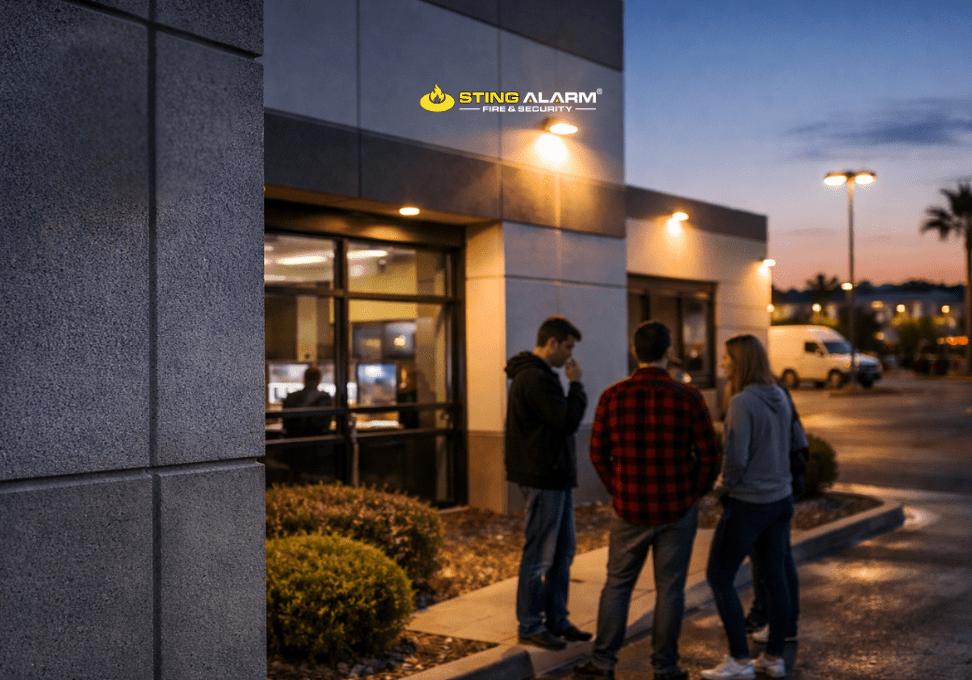

For many businesses, loitering is often seen as a minor issue. However, when you look closer, loitering prevention for businesses is not just about removing unwanted activity. It is about maintaining visibility, control, and accountability across your property.
Someone lingering near the entrance. Groups gathering in parking areas. Activity that does not seem urgent enough to address right away.
However, in a commercial setting, loitering is rarely just about people standing around. It is usually a sign
of limited visibility and control around your property.
Over time, that lack of oversight can impact operations, customer perception, and even liability.
Why Loitering Becomes a Business Problem
Loitering does not always start as a security issue. In many cases, it begins as a gap in awareness.
Without clear visibility at entry points, parking areas, or shared spaces, businesses often do not have a reliable way to track activity.
That leads to:
- Unclear access to your property after hours
- Difficulty verifying incidents or disputes
- Negative first impressions for customers and tenants
- Increased risk of vandalism or theft over time
For business owners and property managers, this creates more than inconvenience. It introduces operational friction and makes it harder to maintain a controlled, professional environment.
In some cases, it can also affect compliance and insurance considerations if incidents are not properly documented.
Where Traditional Approaches Fall Short
A common response to loitering is to rely on occasional patrols or to contact authorities when something feels off.
In practice, this approach is limited.
Law enforcement typically needs clear evidence of illegal activity before intervening. By the time a situation escalates, the damage may already be done.
Standard video systems also fall short when they are only used for recording. While footage can help after an incident, it does not prevent the activity from happening in the first place.
That gap between detection and response is where most issues occur.
Building a More Controlled Environment
Reducing unwanted activity starts with creating a property that is clearly defined, visible, and actively managed.
Foundational steps still matter:
- Clear signage that sets expectations around trespassing and loitering
- Well-maintained exteriors that show active oversight
- Adequate lighting to eliminate dark or hidden areas
- Defined access points to limit uncontrolled entry
These measures help establish boundaries. However, on their own, they are not always enough for high-traffic or multi-tenant environments.
From Visibility to Real-Time Awareness
This is where video surveillance plays a larger role.
The presence of cameras alone can discourage unwanted behavior. More importantly, it provides a way to verify activity and resolve issues with clarity.
For businesses managing multiple entry points or larger properties, visibility becomes a daily operational tool, not just a security measure.
When systems are designed as part of Integrated Security and Fire Protection, that visibility becomes centralized and easier to manage.
Instead of working across separate platforms or vendors, teams gain a consistent view of activity across their property.
A one vendor solution simplifies vendor management, reduces service gaps, and helps keep systems aligned for compliance.
Proactive Protection with Remote Guarding
For businesses that need a more active approach, Remote Guarding adds another layer of control.
Rather than only reviewing footage after the fact, trained professionals monitor activity in real time.
When unusual behavior is detected:
- Activity is immediately reviewed
- A live verbal warning can be issued
- If needed, authorities are dispatched quickly
This approach shifts security from reactive to proactive.
Instead of waiting for incidents to occur, businesses can address situations as they develop. It also helps reduce reliance on full-time on-site guards, supporting more efficient use of security budgets.
Why This Matters for Daily Operations
Loitering prevention for businesses is not just about removing unwanted activity. It is about improving how your business operates day to day.
With better visibility and real-time awareness:
- Teams spend less time investigating incidents
- Customer and tenant experience improves
- Properties remain more organized and controlled
- Risks are identified earlier and handled faster
For property managers, SMBs, and commercial facilities, this creates a more consistent and manageable environment.
A More Efficient Way to Stay in Control
Loitering is often a symptom of something bigger: limited visibility and delayed response.
By combining visibility, proactive monitoring, and integrated systems, businesses can stay ahead of these challenges instead of reacting to them.
Integrated Security and Fire Protection supports that shift by bringing visibility, accountability, and Life Safety into one system that is easier to manage, scale, and maintain.
As a compliance partner, Sting Alarm helps businesses simplify operations with a one vendor solution backed by local expertise and responsive service.
For organizations focused on efficiency, compliance, and long-term reliability, that level of control makes a measurable difference.
