
How Businesses Evaluate the Cost of Remote Guarding Compared to Traditional Security

Security Costs Are Usually Measured the Wrong Way
When businesses look at security costs, the focus often stays on individual line items. Guard services, camera systems, and monitoring are each evaluated on their own, which makes it difficult to understand how well the overall approach is working once everything is in place. What tends to get missed is how those pieces function together day to day.
At Sting Alarm, conversations around remote guarding usually start with coverage. Cost becomes clearer once it’s understood how the property is actually being monitored and where the current approach may be falling short.
Where Traditional Coverage Starts to Break Down
On-site security provides a visible presence, but it’s tied to location and scheduling, which means coverage depends on where someone is positioned at a given time. Camera systems expand visibility across a wider area, but without active oversight, they don’t influence what’s happening in the moment, and activity is often reviewed after the fact rather than addressed as it develops.
These limitations don’t always stand out right away. They tend to surface when something happens outside normal hours or in areas that aren’t being watched consistently.
What Changes When Remote Guarding Is Introduced
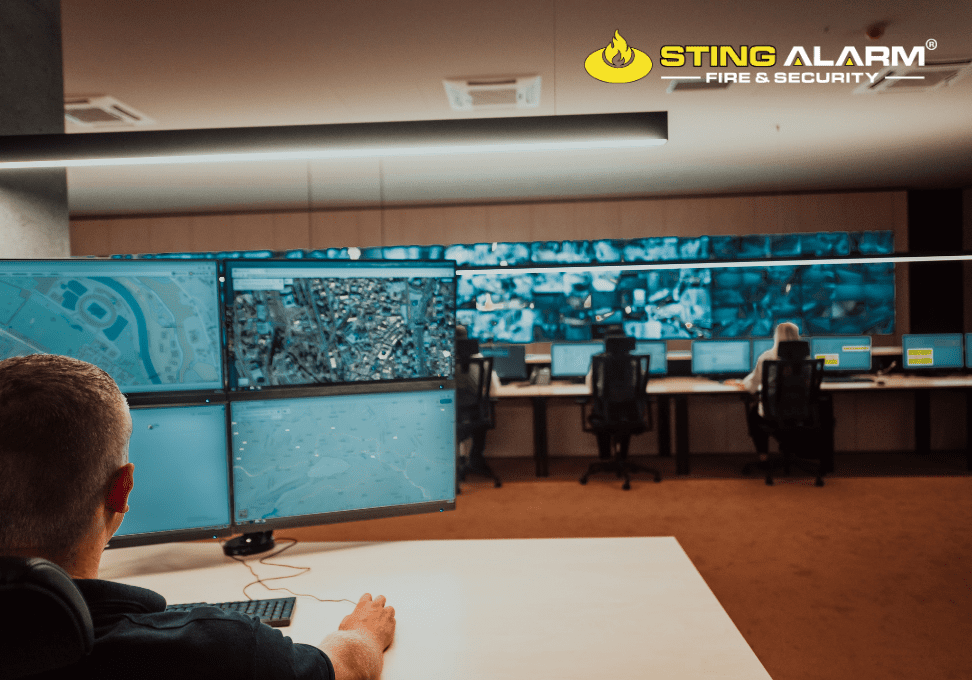
Remote guarding changes how coverage is handled across the property by allowing multiple areas to be monitored at the same time, with alerts routed to trained personnel who can respond as activity unfolds. Instead of relying on a fixed position, the system is structured around consistent oversight.
For businesses, this shifts how performance is evaluated. The conversation moves away from staffing levels and toward how reliably the property is being monitored throughout the day and after hours.
How Businesses Actually Compare the Two
When businesses compare remote guarding with traditional approaches, the discussion tends to center around how the system performs in real conditions. That usually comes down to a few practical considerations:
- How much of the property is covered at any given time
- Whether activity can be addressed while it’s happening
- How consistent coverage is across different hours
- How easily the system can adapt as the property changes
- How well monitoring and on-site systems work together
These factors tend to carry more weight than initial cost because they reflect how the system holds up in day-to-day use rather than just how it’s priced.
Where Remote Guarding Tends to Make the Most Sense
Remote guarding is typically considered in environments where consistent coverage is difficult to maintain, especially across larger properties or locations with multiple access points. In these settings, visibility alone isn’t enough, and having a system that can monitor the entire site and support response in real time becomes more important than maintaining a single point of presence.
If you’re comparing security options and want to understand how remote guarding fits into your current setup, it may be worth reviewing how your property is being covered today. The team at Sting Alarm can walk through your options and help you evaluate what makes the most sense. Call (702) 737-8464 or connect here: https://stingalarm.com/
How Sting Alarm Approaches Remote Guarding
At Sting Alarm, remote guarding is built as part of an integrated system rather than a standalone service. Video, intrusion detection, and monitoring are configured to work together so activity can be identified and addressed without relying on separate systems, which simplifies how everything is managed across the property.
In many cases, existing camera systems can be incorporated into this approach, improving performance without requiring a full replacement.
Security decisions are shaped by how well a system performs over time, not just by the cost attached to each component. Remote guarding gives businesses another way to approach coverage, particularly in environments where traditional methods leave gaps, and the difference becomes clear when performance is evaluated across the entire property rather than in isolated pieces.
If you’re evaluating remote guarding or looking to improve how your current system performs, Sting Alarm can help you work through the options. Call (702) 737-8464 or schedule a consultation here: https://stingalarm.com/
