
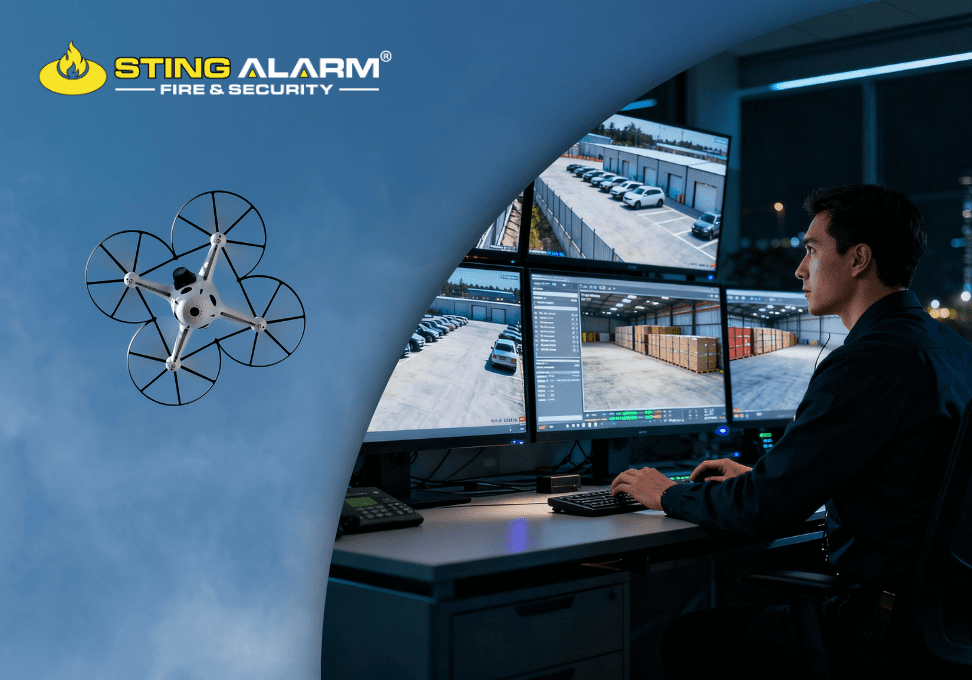
How Remote Guarding and Autonomous Security Drones Work Together to Cover What Fixed Systems Miss

Where Fixed Security Systems Start to Fall Short
Most commercial security systems across Las Vegas are built around fixed positions, with cameras covering specific areas, access control managing entry points, and alarms set around defined zones. That structure works well when activity stays predictable, but it becomes harder to maintain consistent visibility as properties expand or usage changes over time.
We see this most often on larger sites throughout the Las Vegas area, where coverage depends heavily on camera placement or someone physically checking areas that aren’t always in view. The system is still functioning, but it’s tied to a layout that doesn’t always reflect how the property is being used day to day.
How Remote Guarding Extends That Coverage
Remote guarding builds on what’s already in place by turning video into something that can be acted on as activity unfolds. Instead of relying on recorded footage, the system is actively monitored, allowing trained personnel to step in when something doesn’t align with normal conditions.
For many businesses, this is where coverage starts to improve because visibility becomes usable rather than passive. Even so, everything still depends on where cameras are positioned, which means certain areas remain outside that constant view.
Where Autonomous Drones Fit Into the System
This is where drone deployment begins to make a practical difference. Instead of adding more fixed infrastructure, the system gains the ability to move through the property when additional visibility is needed.
Across Las Vegas, this tends to come up on properties with larger footprints, outdoor storage, or multiple access points where maintaining consistent coverage through fixed cameras alone becomes difficult. The drone can follow a set route or respond to activity that has already been identified, giving operators a clearer view without requiring someone to be sent on-site.
How the Two Work Together in Daily Operation
What makes this approach effective is how these systems operate within the same structure. Activity is identified through video or access events, reviewed in real time through remote guarding, and if something needs a closer look, the drone is deployed as part of that same process.
That continuity matters because it avoids the delay that comes from switching between systems or waiting to follow up after the fact. Everything stays connected from detection through response.
If your current system relies on fixed coverage and you’re looking for ways to improve visibility across your property, it may be worth exploring how remote guarding and drone support can work together.
The team at Sting Alarm can walk through your setup and show how these systems can be applied in a practical way. Call (702) 829-7492 or connect here.
What This Means for Coverage Across the Property
For businesses, this changes how coverage is approached. Instead of trying to eliminate every blind spot with additional cameras, the system is designed to extend visibility when and where it’s needed.
In a market like Las Vegas, where properties often include outdoor areas, multi-tenant layouts, or extended operating hours, that flexibility becomes more relevant.
In practice, that usually comes down to a few things:
- Areas that aren’t always in view can still be checked when activity is detected
- Large sections of a property don’t need constant fixed coverage to remain visible
- Response can be based on what’s actually happening, not just alerts coming in
- Coverage can expand without adding unnecessary infrastructure
This tends to be most useful on properties where maintaining constant visibility across every area isn’t practical, but where access and activity still need to be monitored. The system adapts to the layout instead of forcing the layout to fit the system.
How Sting Alarm Implements These Systems
At Sting Alarm, remote guarding and drone deployment are built into a single system rather than treated as separate services. Video, intrusion detection, and monitoring provide the foundation, and drones are introduced where additional coverage makes sense.
This keeps everything operating within the same structure, so activity can be tracked and addressed without creating additional layers to manage. In many cases, existing systems can be incorporated, which allows businesses to expand coverage without rebuilding from scratch.
Conclusion
Fixed systems provide a strong foundation, but they aren’t designed to cover every part of a property on their own. Extending that coverage requires a different approach, one that allows visibility to move beyond fixed positions and respond to conditions as they change.
Combining remote guarding with drone support gives businesses a way to do that without adding unnecessary complexity.
If you’re evaluating ways to improve coverage across your Las Vegas property or want to understand how drone-supported monitoring would apply to your environment, Sting Alarm can help you work through the options. Call (702) 829-7492 or schedule a consultation here.
